
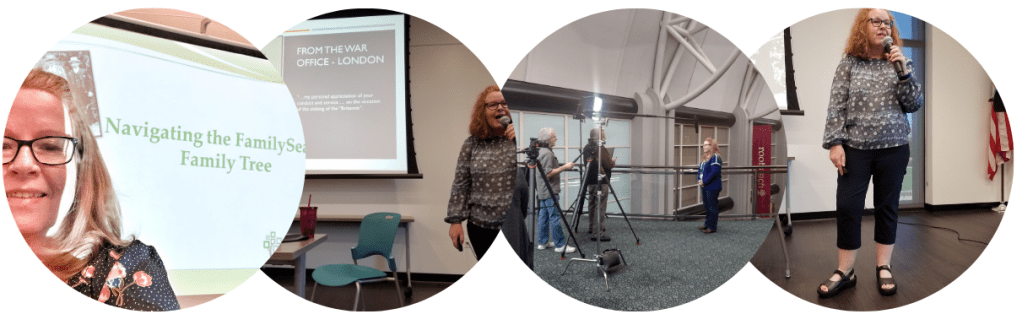
Family history comes alive when it’s shared — and I love bringing genealogical research to life for societies, conferences, and groups of all kinds.
I present on a wide range of topics, from getting started in specific geographic areas to advanced research methodology and case studies. Whether your group is full of seasoned researchers or enthusiastic beginners, I’m happy to tailor a presentation to suit your audience. I present both virtually and in person, and if you don’t see a topic below that fits your needs, feel free to reach out — I’m always happy to discuss other options.
The presentations below are organized into broad geographic and topical categories to make browsing easier. However, many presentations draw on records, case studies, and methodology from multiple locations — so if you’re looking for a U.S.-focused presentation, for example, you may find relevant options in the Methodology category as well. It’s worth browsing the whole list!
Just wanted to say a huge thank you for your three excellent sessions on South African Genealogy at RootsTech Connect. I have now watched them all and downloaded the superb handouts for each. The focus you placed on using the Images facility in FamilySearch was a great pointer.
— Jane W., Hampshire, England
General Categories:
United States
England
South Africa
Isle of Man
Methodology
United States
Following the Family: Migration Patterns as Proof of Relationship
When documentary evidence is scarce, migration patterns can provide compelling proof of family relationships. Using the Craft and Gaylord families’ journey from Iowa to California as a case study, this presentation explores how a range of record types can be combined to establish family connections across state lines.
Testing Family Legends: When Oral History Meets the Archive (Available after 31 December 2026)
Family stories passed down through generations can be a valuable starting point — but how do you prove or disprove them? Using a Craft family legend from California as a case study, this presentation explores strategies for evaluating oral history against the archival record and writing GPS-compliant conclusions from the evidence gathered.
Mining Probate Records: Wills, Estates, and Contested Inheritances
Probate records are among the richest sources available to genealogical researchers, often naming family members and revealing relationships that appear nowhere else. Using the contested estate of Thomas Lantry of St. Lawrence County, New York as a case study, this presentation demonstrates how even a disputed inheritance can unlock your family history.
Researching Michigan’s Pioneer Generation: Territory to Statehood Records
Michigan’s pioneer era produced a wealth of records that can bring your earliest ancestors in the region to life. This presentation explores the key sources available for researching ancestors in Michigan from the territorial period through statehood, including land patents, territorial census records, early county marriage registers, city directories, and newspapers.
Beyond the Pension File: Mining a Confederate Widow’s File for Research Clues
Confederate widow pension files are a goldmine of genealogical information, often containing far more than a simple pension application. Using a Texas case study, this presentation demonstrates how to extract every possible research clue from a pension file, including leads to other record types that can extend your research in unexpected directions.
Old, Blind, and Contested: A Confederate Widow’s Final Years
Sometimes the most revealing family stories are found in the records created at the end of a life. Using the pension file of Kate Mays of Texas as a case study, this presentation explores how pension records can uncover the personal struggles, family dynamics, and legal battles that shaped your ancestor’s final years.
England
Then the Truth Finally Came Out: Wartime Secrecy, Suppressed Losses, and the Newspapers that Broke the Story
Wartime censorship left many English families — and today’s researchers — in the dark about how and why ancestors died on active service. Using a compelling WWII case study, this webinar teaches a systematic methodology for researching suppressed losses through newspaper archives and integrating those findings with official records.
Do You Have a Cousin Jack in Your Family?
“Cousin Jack” was the nickname given to Cornish miners who emigrated across the globe in search of work during the 19th century. Using the Bastian family’s journey from Cornwall to the American Southwest as a case study, this presentation explores the history of Cornish migration and the records that can help you identify and trace your Cornish mining ancestors.
Making the Most of GENUKI
GENUKI is one of the most comprehensive free online resources for British and Irish genealogical research. This presentation explores how to navigate this valuable website and get the most out of it, with practical tips for locating the records, repositories, and local information most relevant to your research.
Using Criminal Records to Break Down Your Brickwalls
Criminal records are an often-overlooked source that can provide a wealth of detail about your English ancestors. Using a County Durham bigamy case as a case study, this presentation explores the range of criminal records available — including prison calendars, criminal registers, and court records — and demonstrates how combining them with newspaper research can reveal a far more nuanced story than the charge alone might suggest.
English Poor Law Records: Settlement Certificates, Removal Orders, and Bastardy Bonds
Poor Law records are among the most detailed and personal documents surviving from English parish history. This presentation explains what settlement certificates, removal orders, and bastardy bonds are, what information they contain, and how to locate and use them in your research.
Parish Chest Records: The Hidden Treasure of English Genealogy
Beyond the parish register lies a wealth of records that many genealogists have yet to discover. This presentation explores the rich variety of documents found in the parish chest and demonstrates how these often-overlooked sources can add remarkable depth to your English family history.
Leaving Liverpool: Tracing Ancestors’ Emigration from the World’s Greatest Departure Port
For millions of emigrants, Liverpool was the last piece of England they ever saw. Using the Keown family’s journey from the Isle of Man to Melbourne in 1854 as a case study, this presentation explores the records generated by emigration through Liverpool and demonstrates how to trace your ancestor’s emigration story from departure to arrival.
South Africa
Getting Started with South African Research
South Africa’s complex history has shaped the records available to genealogical researchers in fascinating ways. This presentation explores how major historical events influenced record creation and survival, how shifting geographical boundaries affect where records are held today, and surveys the key record types, including church records, estate files, cemetery records, settler records, and military records.
South African Research: My Ancestor in South Africa
This presentation focuses on ancestors who settled in South Africa and explores the assisted emigration schemes that brought many families to the region. We examine the 1820 British Settlers, British Settlers to Natal, and German and Norwegian settlers, along with passenger lists, deeds of naturalization, and immigrant registry files.
South African Research: Military Research
This presentation explores the records available for ancestors who fought in the Anglo-Boer Wars, including a brief history of the conflict and the records it generated. We’ll also look at how newspapers can help locate military ancestors, and examine South Africa’s role in World War I and II, and the records available for each.
Online Sources for South African Research
This presentation surveys the key online sources for South African genealogical research. We’ll also examine major record collections at online repositories and libraries, and look at resources for adding historical and social context to your research.
South African Boer War Prisoners — Case Study
The Boer War generated a remarkable range of records that can shed light on your South African ancestors. Using the Pretorius family as a case study, this presentation demonstrates how Boer War prisoner records can break through brick walls and add depth to your family history.
Your presentations and handouts were the best I’ve seen so far. I am starting to research family from Kimberley with only a medal from the Boer War and the names of a father and two daughters. Your information has made it seem not so daunting a task.
— Webinar Attendee
Isle of Man
Getting Started with Isle of Man Research
Tucked in the Irish Sea between Great Britain and Ireland, the Isle of Man has a fascinating history and a rich genealogical record set all its own. This presentation introduces the key record types available for Manx research — including civil registration, church records, census, probate, land and manorial records, and newspapers — and surveys the major online repositories and websites where they can be found.
Emigration from the Isle of Man
Economic hardship, declining industries, and the lure of gold rushes drove thousands of Manx emigrants to seek new lives far from home. This presentation traces emigration from the Isle of Man from the 1600s through the early 1900s, exploring the push and pull factors that sent Manx families across the globe and the records that can help you follow them there.
Methodology
Fill in the Dash
Between every birth date and death date lies a dash — and that dash represents a life waiting to be discovered. This presentation explores how genealogical research can bring your ancestors to life using a range of record types, following the remarkable story of Charlotte Lillie Davis, an unmarried English nurse who survived the sinking of the Britannic in 1916, as a case study in filling in that dash.
Starting on the Right Foot: Locality Surveys
Jumping straight into records without understanding the place you’re researching is a bit like arriving in a foreign country without a map. This presentation shows you how to build a locality survey — getting to know the history, geography, record types, and repositories of your research area before you start — so that when you do dive in, you know exactly where you’re going.
Document, Doubt, Discover: A Case Study in Genealogical Research Strategy
Good genealogical research isn’t just about finding records — it’s about questioning what they tell you and knowing where to look next. Using the life of Daniel L. Case of Lansing, Michigan, as a cradle-to-grave case study, this presentation walks through a complete research strategy from initial documentation through conflict resolution and final conclusions, demonstrating how doubt can be as valuable a tool as discovery.
The FAN Club Method: Cluster Research for Breaking Down Brick Walls
When your ancestor seems to have vanished from the records, the people around them may hold the key. This presentation introduces the FAN Club method — researching the Friends, Associates, and Neighbors of your ancestor — and demonstrates how expanding your research beyond the immediate family can break through even the most stubborn brick walls.
The Circle Around Your Ancestor: Cluster Research in Practice
Your ancestor rarely lived in isolation — they migrated with neighbors, witnessed each other’s documents, and settled near family and friends. This presentation introduces the principles of cluster research and demonstrates how expanding your focus beyond the direct line to include the people around your ancestor can open up entirely new research avenues and break through even the most stubborn brick walls.
Stop Searching Harder, Search Wider: The FAN Club Method in Action
When the trail goes cold on your ancestor, stop searching harder — search wider. Using two real-world case studies, an Irish-American emigrant family traced across two continents and a Michigan pioneer and politician, this presentation teaches the FAN Club method through document-by-document walkthroughs across baptism registers, land plats, naturalization records, and county histories. Attendees leave with a practical five-step framework they can apply to their own brick walls immediately.
Context is Everything: Using Historical Research to Bring Your Ancestor to Life
You’ve found your immigrant ancestor in the census and tracked down their baptism — but do you know why they left Ireland? Why did they choose that particular corner of New York over everywhere else in America? What was the cost of the journey, and how long did it take? Using an Irish emigrant family’s journey to upstate New York as a case study, this presentation shows how emigrant guides, population tables, land laws, agricultural records, and county histories can transform your research — and your ancestors — from names on a chart to real people with real stories.
Silent Voices: Researching the Unmarried Women in Your Family Tree
In genealogy, women are too often identified only through their relationships to the men in their lives, most often their husbands. But what about the women who never married? Using a case study of an Englishwoman whose fascinating life story was documented entirely outside of marriage, this presentation explores the rich records available for unmarried women and demonstrates research strategies that apply across any country and collection, revealing lives far more fascinating than the family tree suggests.
The Clues Left Behind When They Emigrated (Coming to RootsTech 2027!)
When an ancestor emigrates, the paper trail doesn’t always follow them — but the records left behind in their home country often tell you where they went and when. Using examples drawn from multiple countries and record types, this presentation explores how gravestones, census records, newspapers, and other sources in the country of origin can hold the very clues you’ve been searching for at the destination end.
Sue spoke in an even, engaging tone and gave a lot of information in a short time, which kept me on my toes. It can be difficult to keep me engaged at 8AM! She spoke to the audience and used her handout to augment her talk — a practiced skill. Well done. I will look forward to hearing other classes by her.
— Cheryl
Please use the form below to contact me, or email me directly at sue.mcnelly@gmail.com


